
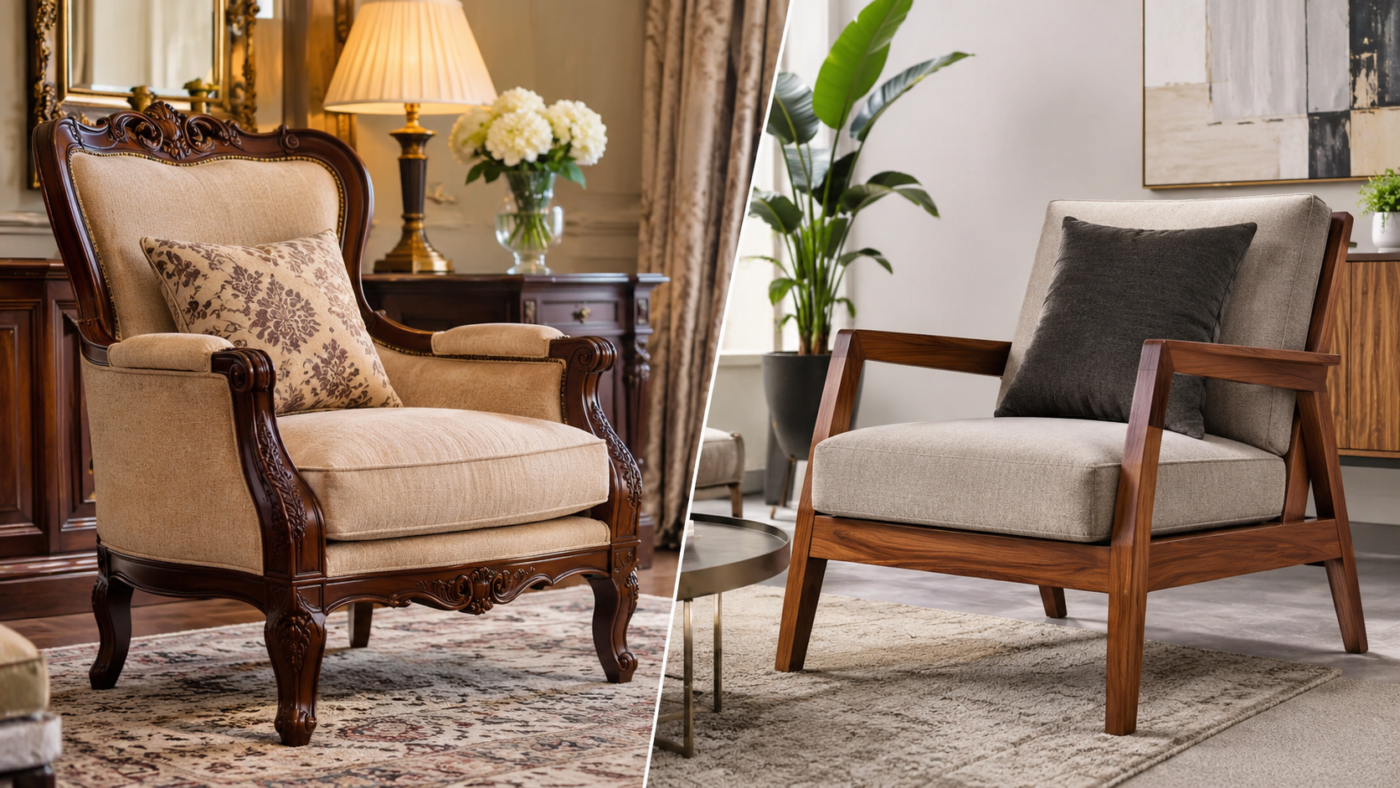
A wooden armchair is rarely an impulse buy. It stays in the corner of your living room for a decade or more, gets dragged towards the window for reading, and is usually the first seat a guest chooses. Getting it right comes down to five things: how the chair is built, the style of its lines, the timber it is made from, how it sits beside your sofa, and the fabric wrapped around the frame. Here is how to judge each one.
Anatomy of a Quality Wooden Armchair
Start with what photos hide. The frame carries everything, so look at how the joints are made. Mortise-and-tenon or dowelled joints, glued and reinforced with corner blocks, hold up far longer than frames that are simply stapled or screwed together. Ask whether the arms and legs are solid wood too, because they take the most strain every time someone sits down or stands up.
Then sit in it. Your feet should rest flat on the floor, which usually means a seat height of around 40 to 45 cm. The seat depth should support your thighs without pressing behind your knees, and the arms should meet your elbows without lifting your shoulders.
Proportion matters as much as comfort. A bulky chair swallows a compact apartment, while a slim one looks lost in a double-height villa majlis. When standard sizes do not suit the room, a custom made armchair lets you set the width, depth and height around the space instead of the other way round.
Finally, run a hand over the surfaces. Every edge should be smoothly sanded and the finish even, with no rough patches where the arm meets the back. Hidden areas, such as the underside of the seat, show how much care went into everything else.
Classic Carvings vs. Clean Contemporary Lines
Classic armchairs earn their place through detail: a carved crest on the backrest, scrolled arms, curved cabriole legs, sometimes tufting or a gilded finish. They belong in formal living rooms and majlis settings with high ceilings, panelling and a chandelier, where the chair is meant to be noticed.
Contemporary designs do the opposite. Straight or gently tapered legs, slim arms and an open frame let the grain of the wood do the talking, and they carry less visual weight in an open-plan living and dining area.
You do not have to pick a side completely. A transitional chair, with restrained carving on an otherwise simple frame, bridges both. One practical point for the UAE: carved detail collects dust, so ask how the carving is finished and whether it wipes clean easily.
Selecting Durable Hardwoods for Long-Term Use
Hardwood suits armchairs because the frame is under constant leverage from people getting in and out. Three species come up most often:
- Teak: naturally oily and stable, resistant to moisture and wear, with a golden-brown tone that deepens over time.
- Oak: heavy, strong and clearly grained, and it takes stain well, so it works in both traditional and modern rooms.
- Walnut: darker with a finer grain and a richer look. It is slightly softer than oak but still a dependable hardwood for seating.
Finish affects long-term wear as well. A well-applied lacquer or oil protects against spills and everyday scratches, and a solid frame can be refinished years later, which veneered board rarely allows.
Local conditions matter too. Air-conditioned rooms dry the air, and timber that was not properly kiln-dried can shrink and loosen at the joints. Ask the maker how the wood is dried, and keep the chair out of strong direct sunlight to protect the finish. At DecoArt, our armchair frames are built in solid teak, oak and walnut.
Coordinating Armchairs with Your Main Sofa Set
An armchair should relate to the sofa, not copy it. A perfect match from the same set can feel flat, while too much contrast makes the room look unplanned. A few rules keep it balanced:
- Echo the wood tone. Repeat the finish of the sofa frame, coffee table or side tables on the armchair legs and arms.
- Vary the upholstery. Choose a different colour or texture from the sofa, but stay within the same palette.
- Watch the scale. Seat and arm heights should sit within a few centimetres of the sofa, so one does not tower over the other.
- Leave room to move. Angle the chair towards the sofa and keep a clear walkway of roughly 80 cm.
Use the sofa’s arm height as your guide, and the two pieces will read as one conversation. In a classic majlis, a pair of matching armchairs facing the sofa works well. In a modern living room, a single statement chair in a contrasting fabric is often enough.
Upholstery Fabrics That Complement Exposed Wood
With an exposed frame, the fabric and the timber are always seen together, so they need to agree. Velvet adds depth and pairs beautifully with carved teak or dark walnut. Linen blends and textured weaves soften oak and clean-lined frames. Leather is the easiest to wipe down, which helps in homes with children, and it looks sharp against walnut.
For daily seating, check the fabric’s abrasion rating. A Martindale figure of around 20,000 rubs or more is a common benchmark for a chair that will be used every day.
On colour, warm woods such as teak and oak sit well with cream, sage, navy and terracotta, while dark walnut looks good against ivory, camel and deep green. Always ask for swatches and look at them in your own living room light, because showroom lighting can change how a shade reads.
Before you order, sit in the chair, inspect the joints, ask about the timber and take swatches home. A wooden armchair that fits your room, your sofa and your daily routine will outlast any passing trend, and seeing the frames and finishes in person at the DecoArt showroom makes the decision much easier.
