
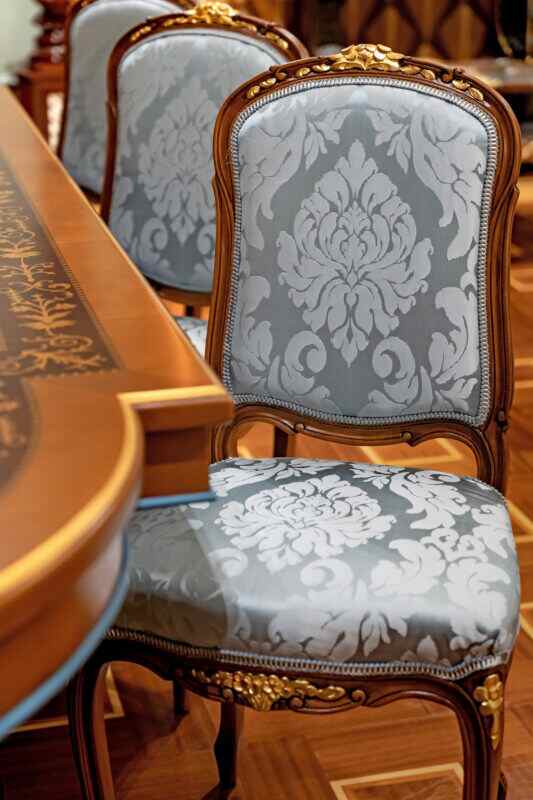
Run your hand across a good marquetry tabletop, and you won’t feel a single seam. Look closer, though, and you’ll find hundreds of separate pieces of wood, each cut by hand and fitted against its neighbour like a jigsaw puzzle.
That contrast is what makes marquetry so special. It reads as one smooth surface, but it’s really an image built from wood.
If you’re thinking about a marquetry dining table, dresser, or coffee table, it helps to know how it’s made, what separates good pieces from average ones, and how to look after one in a Dubai home.
What Marquetry Actually Is
Marquetry is the art of building pictures and patterns from thin sheets of wood veneer. Each veneer is usually well under a millimeter thick. The craftsman cuts shapes from different woods, fits them together into a single decorative sheet, then glues and presses that sheet onto the surface of a piece of furniture.
That pressing step is where the “wood pressing” idea comes from. Without even pressure while the glue sets, the veneer would bubble, lift, or crack.
Marquetry is often confused with two related crafts. Parquetry uses the same technique but sticks to geometric shapes, like the cubes and diamonds you see on some tabletops. Inlay is different again: the craftsman cuts recesses into solid wood and sets the decorative material into them.
Many pieces mix all three. A dresser might have a floral marquetry panel on the front, a parquetry border, and brass or mother-of-pearl inlay around the handles.
A Short History
The word comes from the French marqueter, meaning to mark or variegate. The craft reached its peak in 17th and 18th century France, where cabinetmakers to the royal court produced furniture covered in flowers, birds and scrolling vines made entirely of wood, tortoiseshell and metal.
The Middle East has its own long tradition of decorative wood. Damascus is still known for furniture inlaid with mother-of-pearl, bone and contrasting woods, a style that sits comfortably in many Emirati majlis rooms today.
How a Marquetry Panel Gets Made
The process starts with a drawing. The design is traced and numbered so every piece has a place.
Next comes choosing the woods. This is where the artistry really shows. A craftsman picks walnut for a shadow, maple or sycamore for a highlight, and something like padauk or rosewood when a design needs a warm red. Grain direction matters as much as color, because grain catches light differently depending on which way it runs.
Cutting is slow, precise work. Traditional makers use a fine fret saw or a sharp knife. Some stack several veneers and cut them together so the pieces match perfectly. Today, many workshops use laser cutting for complex patterns and finish the rest by hand.
One old trick still in use is sand shading. The craftsman dips the edge of a veneer piece into hot sand for a few seconds, which scorches it slightly and creates a soft shadow. It’s how a flat petal starts to look curved.
The pieces are then assembled face down on tape or paper, glued to a stable base board, and pressed. Older workshops used heavy screw presses. Most now use hydraulic or vacuum presses, which spread pressure more evenly across a large tabletop.
After pressing, the surface is scraped, sanded, and finished. The finish protects the wood and brings out the color.
Marquetry Dining Tables
A dining table is the boldest place to use marquetry. It’s the surface everyone sits around, and it gets looked at more than almost anything else in the house.
Designs range from a single central medallion to a full tabletop covered in pattern. For a large family table, a border pattern around the edge often works better than a busy center, because plates and serving dishes cover the middle anyway.
The finish is the key decision. A dining table faces hot dishes, spilled juice, and daily wiping. Ask for a durable lacquer or polyurethane topcoat rather than a delicate wax or oil finish.
If you’re planning a formal dining room, browse our dining table collection for shapes and sizes that pair well with a marquetry top.
Marquetry Dressers
Dressers are where marquetry has always looked most at home. Drawer fronts give the craftsman a series of panels to work with, so a single design can flow across the whole front of the piece.
A good maker lines the pattern up across every drawer. Pull one drawer out and the image breaks. Push it back and the picture is whole again. That kind of alignment takes real planning, and it’s a quick way to judge quality.
Dressers also see less wear than tables. That makes them a good choice if you want finer, more delicate work, like detailed florals or sand-shaded figures.
You’ll find dressers and other storage pieces in our bedroom furniture range.
Marquetry Coffee Tables
A coffee table sits at the center of the living room, so it acts as a natural focal point. Because you view it from above, marquetry on the top really shows off. Round and oval coffee tables suit radiating patterns, like a compass rose or a sunburst. Rectangular tables work well with framed panels or a repeating geometric border.
Coffee tables take a surprising amount of abuse: feet, remote controls, mugs, kids’ homework. Choose a hard-wearing finish and keep coasters within reach.
For ideas on how a statement table fits into the wider room, take a look at our living room furniture collection.
What to Check Before You Buy
Look at the joints first. On good work, the seams between pieces are nearly invisible. Gaps filled with dark filler are a sign of rushed cutting.
Ask what the veneer is glued to. A stable base like high-quality plywood or MDF holds up better than solid wood, which expands and contracts and can crack the veneer over time.
Check the finish in raking light. Hold your phone flashlight low across the surface and look for ripples, bubbles or patches where the veneer has lifted. Ask whether the work is hand-cut, laser-cut, or both. Neither is wrong, but the answer should reflect the price.
Caring for Marquetry in Dubai
Our climate is hard on wood. Air conditioning dries out indoor air for most of the year, and that dryness can make veneers shrink and lift at the edges. Keep marquetry pieces away from AC vents and out of direct sunlight. Strong sun fades colorful woods quickly, and the contrast that makes the design work slowly disappears.
Wipe with a soft, barely damp cloth and dry it straight away. Skip silicone furniture sprays, which build up and make future repairs harder. If you notice a small piece lifting, deal with it early. A craftsman can re-glue a loose section in minutes. Leave it, and it can snag and tear.
Bringing Marquetry Into Your Home
DecoArt has been making handmade classic furniture in Dubai since 1989, with our own manufacturing unit next to our showroom. That means we can tailor designs, woods, and finishes to your space rather than picking from a shelf.
If you’d like to see the craftsmanship in person, visit our showroom. Or, if marquetry is part of a bigger plan for your villa, our interior design solutions team can help you place each piece so it gets the attention it deserves.

Pingback: Luxury Furniture Trends for Elegant Homes | DecoArt